A new homeowner's first property tax bill in Austin often arrives with a bit of sticker shock, especially for buyers relocating from lower-tax states. The good news: a few straightforward filings can meaningfully reduce that number, and most of them are free. The Dillar Group walks nearly every first-time buyer through this process, because the single biggest mistake new owners make isn't overpaying for a home — it's forgetting to file for the exemption they're already entitled to.
The Homestead Exemption: File This First
As of the 2026 tax year, the mandatory school-district homestead exemption in Texas is $140,000 — up from $100,000 in prior years following a 2025 ballot measure. This exemption reduces the taxable value used to calculate the school district portion of a property tax bill, which is typically the largest single component of an Austin tax bill. Homeowners age 65 or older, or those with a qualifying disability, receive an additional $60,000 on top of the standard amount, for a combined $200,000 reduction in taxable value for school taxes.
To qualify, a homeowner must own the property and occupy it as their primary residence as of January 1 of the tax year. The filing deadline is generally April 30, though Texas law allows retroactive filing for up to two prior tax years if a deadline was missed — meaning a new owner who forgot to file isn't permanently out of luck, but shouldn't delay any longer than necessary either.
The Appraisal Cap: Protection That Builds Over Time
Once a homestead exemption is on file, a second protection kicks in: the appraisal cap, which limits how much a property's appraised value can increase for tax purposes in a single year, regardless of how much the market value has actually risen. This cap is set at 10% annually under Texas Tax Code Section 23.23, and it begins the January 1 following the year the exemption is approved — which means filing late costs a homeowner a full year of that protection.
Over time, this cap becomes increasingly valuable in a market like Austin's, where home values have risen substantially over the past decade. A homeowner who has held a property for several years often finds their appraised value sitting meaningfully below current market value, purely because of the cap's cumulative effect.
How the Bill Breaks Down
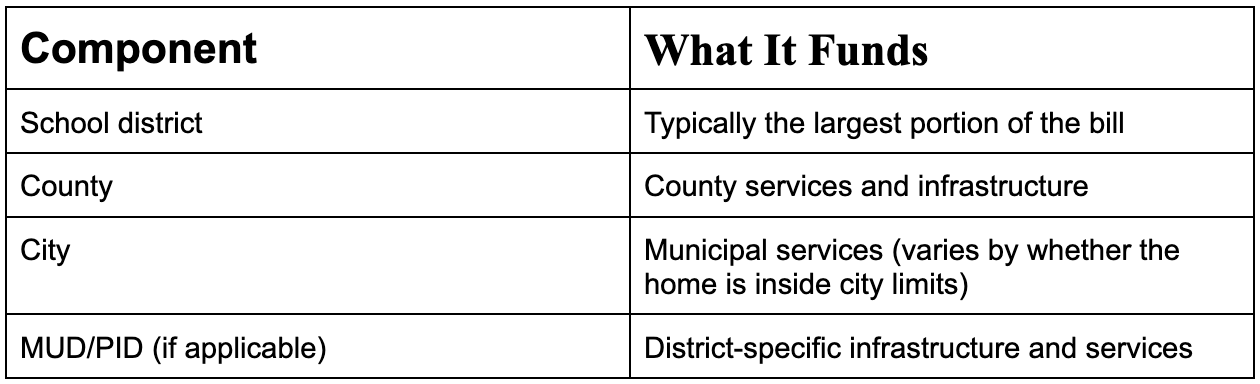
A typical Austin property tax bill combines several separate taxing entities: the school district, the county, the city, and sometimes a special district such as a MUD or PID. School district taxes generally make up the largest share of the total bill. Effective tax rates across the Austin metro currently range from roughly 1.78% in some western Hill Country municipalities up to around 2.71% in parts of the metro further from the urban core — meaning the specific city and school district a home falls within meaningfully affects the total bill, sometimes by thousands of dollars a year on comparably priced homes.
Filing Steps for New Homeowners
Filing a homestead exemption requires submitting Form 50-114 to the relevant county appraisal district — Travis, Williamson, or Hays, depending on the property's location — along with proof of primary residency, typically a driver's license or state ID showing the property's address. The application itself is free and generally takes only a few minutes to complete online through the appraisal district's website.
"New owners assume the exemption applies automatically at closing. It doesn't — filing is a separate step, and it's the single most commonly missed task in the first year of homeownership."
Once approved, the exemption does not need to be refiled annually as long as the homeowner continues occupying the property as their primary residence, though appraisal districts occasionally request reverification. It's worth checking the property record on the relevant appraisal district's website after filing to confirm the exemption is actually showing, rather than assuming submission alone completed the process.
Local Context: Why This Varies by Address
Because school district tax rates and municipal rates vary so significantly across the Austin metro, two buyers looking at similarly priced homes in different parts of the metro can end up with meaningfully different tax bills. This is worth factoring into a home search specifically — a home a few miles away in a different taxing jurisdiction can carry a materially different annual cost even at an identical purchase price, and it's a detail worth confirming for any specific address under serious consideration.
Data referenced above reflects Texas homestead exemption and appraisal cap rules current as of the 2026 tax year, following the 2025 ballot measure that raised the exemption amount. Filing deadlines and exemption amounts should be reconfirmed with the relevant county appraisal district before acting, as these figures are set at the state level and can change with future legislation.
Want help understanding what a specific property's total tax picture looks like before you buy? The Dillar Group can help pull the numbers together. Get a property tax briefing.