The average 30-year fixed mortgage rate hit 6.76% this week, according to Freddie Mac's weekly survey, a one-year high, up from 6.71% just a week earlier. For Austin buyers who've been watching rates and waiting for a clearer signal, that's a useful data point, but it isn't the whole story. Dillar Schwartz, with The Dillar Group talks through this exact question with nearly every buyer right now: what does a rate like this actually mean for a monthly payment, and is waiting really the better play?
Where Rates Actually Stand
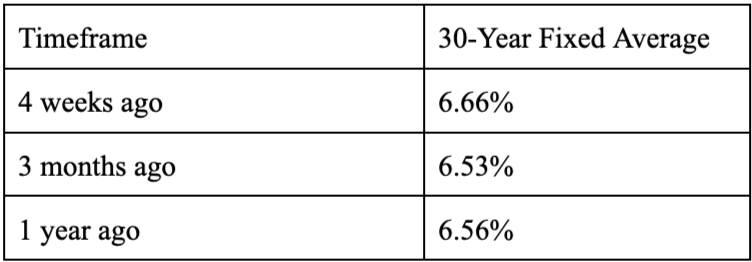
As of the most recent reading, the 30-year fixed sits at 6.76%, with the 15-year fixed close behind at 6.09%. Four weeks ago, the 30-year averaged 6.66%, meaning rates have drifted upward over the past month rather than continuing the modest relief many buyers were expecting earlier in the year. Looking back further, the current reading sits slightly above both the three-month-ago mark (6.53%) and the one-year-ago mark (6.56%), which puts current conditions in a narrow, relatively stable band rather than a dramatic swing in either direction.
Major forecasting groups have offered a range of outlooks for where rates head next, some project rates holding in the mid-6% range through the rest of the year, while others see modest downward drift depending on inflation data and Federal Reserve decisions. Rather than betting a home search on any single forecast, it's more useful to understand the actual payment math at today's rate and decide from there.
What This Means If You're Buying
On a $450,000 loan at 6.76%, principal and interest alone runs approximately $2,925/month, compared to roughly $2,870/month at last month's 6.66% average, a modest but real difference. The bigger point for most buyers isn't the exact rate on a given week; it's that today's payment is calculable and actionable, while a hypothetical future rate is not. Buyers who delay a purchase specifically hoping for a meaningfully lower rate are making a bet on a forecast, not a guarantee, and in the meantime, home prices in most Austin submarkets continue moving independently of rate direction.
A strategy worth discussing with a lender: buying now at the current rate with a plan to refinance if rates genuinely drop meaningfully later, rather than waiting indefinitely for a rate environment that may or may not materialize on a predictable timeline. Refinancing later generally involves closing costs, but it also comes without the risk of the home's price rising in the meantime.
What This Means If You're Selling
Elevated rates continue to affect buyer purchasing power broadly, which means pricing accuracy matters more than it did in a lower-rate environment. A buyer working with a $2,925 monthly payment target at today's rate simply qualifies for a smaller loan amount than the same buyer would have a few years ago at a lower rate — sellers should expect this to shape realistic offer ranges, particularly in price bands where buyers are most rate-sensitive.
"Buyers keep asking us to time the rate perfectly. Nobody can do that reliably — what we can do is run the real numbers at today's rate and make a decision that works regardless of what happens next."
Rate Buy-Downs: A Tool Worth Understanding
Many builders and some sellers are currently offering rate buy-downs — either temporary (lowering the payment for the first year or two before reverting to the note rate) or permanent (paying points upfront to secure a lower rate for the full loan term). These can meaningfully change the math on new construction specifically, and it's worth asking directly whether a buy-down is available and running the numbers against a straight-rate purchase before assuming one option is automatically better than the other.
Local Context: Why Austin Buyers Feel This Differently
Because Austin home prices moved up substantially during 2020–2022 before partially correcting, current-rate payment math here often lands differently than in metros where prices never ran up as sharply. A buyer comparing today's Austin payment to what a similar loan would have cost in 2019 sees a larger gap than a buyer in a market with less dramatic price appreciation — worth keeping in mind when a relocating buyer's rate expectations are anchored to a different metro's history.
What Actually Drives Rate Movement
It's worth understanding that mortgage rates don't move in direct lockstep with Federal Reserve rate decisions, even though the two are often discussed together. The 30-year fixed rate tracks more closely with the 10-year Treasury yield, which itself responds to inflation expectations, broader economic growth signals, and investor sentiment — factors that can push rates in a different direction than a Fed meeting outcome alone would suggest. This is part of why rate forecasts vary so widely between different economists and institutions even when they're looking at the same underlying data.
Want to see what today's rate actually means for your specific budget? The Dillar Group can connect you with a lender for a real payment estimate. Get a payment estimate.
Rate data referenced above reflects Freddie Mac's Primary Mortgage Market Survey as of September 10, 2026. Mortgage rates move week to week and should be reconfirmed with a current lender quote before making any purchase timing decision.